Saturday, April 16, 2011

Embracing Our Differences

I am pleased to feature Mary Kay Milewski as a guest blogger. I recently attended a social media seminar with Mary Kay and another guest blogger Al Mendez. Experience as both a Human Resource Manager, Executive Training Manager, as well a Dental Practice Administrator, has uniquely positioned Mary Kay Milewski to understand the complex challenges of practicing dentistry in times of exponential change. As an instructor in the Workforce Development Department of the University of Akron, Mary Kay teaches management skills to a wide variety of business including manufacturing, healthcare and service organizations. Her realistic, refreshing approach to areas such as Leadership, Communications, Conflict Resolution and Change Management have given her clients hands on tools to improve the bottom line of their company and to develop their most important asset – their people.

I live in two worlds. I manage my husband’s dental practice in North Eastern Ohio, but I am also a contract trainer for a local university which sends me into a wide a variety of companies to do management training. The management problems we face in dentistry today are really no different than those I see all over the manufacturing and service sectors of our economy. People are people no matter what their profession.

One problem I hear over and over again is how to manage the challenge of generational differences in the workplace. Specifically, managers and supervisors ask me why the “twenty something kids” don’t want to work. And expect to be made a manager during their first week of employment. And leave each day at 4:00 pm on the dot. The younger members of their workforce roll their eyes and ask me why the shall we say “more seasoned” coworkers still can’t figure out how to put an attachment into an email, and why it is such a big deal for “old people” to try something new.

Generational Differences are as old as time. I am sure somewhere deep in a cave somewhere is a hieroglyphic that says “What is with these young kids today?” Each generation has a natural desire to break with the past, to push boundaries, to try to do things differently. I grew up in the 1960’s near Kent State University…generational differences were very alive and well. And while we wrote music and books on our view of the world, once in the workforce, our generations blended together well.

So what’s different now? One of the biggest culprits is the pace of change. Generations used to be divided into periods of twenty to thirty years. A recent New York Times article cited research being done that pointed to technological changes so profound as to dramatically change how young people communicate…every three to five years. Think about it…an eight year old has been raised reading books, but your toddler will view a book as something you download. An eighteen year old will not answer an email or “shudder” an archaic voicemail but send them a text and you get instant response. But their twenty five or thirty year old sibling will be much more open to using email because texting wasn’t part of their adolescence. We’ve created profound intra-generational shifts that will inevitably impact how younger generations communicate and interact with an increasingly complex world.

So what to do? As with all things, first take a deep breath and realize that you cannot stop the change that is coming at us like a runaway train. Stop trying to pound a square peg into a round hole and embrace these generational differences. Accept that a different view is not necessarily a bad thing, but rather that a gift that can help you consider new ways to solve old problems. Embrace these differences instead of trying to make everyone think like you. And get used to change. It’s here to stay.

Friday, April 8, 2011

What Ever It Takes


I am pleased to present my guest blogger, Dr. Al Mendez. Albert Mendez is a practicing dentist in SE Kansas. He is married and the proud father of 5—four college age and one in high school. He attended Brigham Young University in Provo, UT. He received his Doctor of Dental Surgery Degree at the University of Nebraska Medical Center College of Dentistry in Lincoln, NE. He enjoys walking, snow skiing and riding his Harley Davidson Heritage Classic. He has recently been elected to his local school board.

I know what I am about to say just might sound ironic. I write a blog and I Facebook, and yet I consider myself a somewhat private person. How is that possible? I suppose I consider myself private because I do not "confess" past or current "sin and shortcomings" in public. I grew up the son of a hardworking steelworker in a middle class community in the south suburbs of Chicago. It was not uncommon for Dad to work 12-16 hours per day. Throughout my growing up years, Mom was a stay at home mom. She ran a very tight ship. I admire my parents for all they did for my siblings and me. I am the person I am today mostly because of their attitude and teachings. Do whatever it takes!!!

My common, everyday life was never much to talk about; after all every one lived that way, right? It was nothing to be ashamed of, nor was it much to brag about. Recently I was talking with one of my team members about working my way through college and dental school. I told her about how I worked in a meat processing plant moving product from storage to the processing floor and back. I helped in the "ground beef" room--pushing the meat into the grinders, extruding it into one to ten pound chubs, boxing the chubs, etc. On occasion I would drive a refrigerated flat truck to pick up or deliver the meat all over Nebraska, Iowa, and even Minnesota.

I also mentioned doing custodial work. I had a couple of different custodial jobs. One required me to keep tiled floors and stairways clean. I was responsible for sweeping, mopping and stripping and waxing these floors. Yet another job consisted of pulling trash and vacuuming carpets in office buildings around Lincoln, NE. She was amazed at the things I did. It was neither glamorous nor demeaning work. It just needed to be done!

As I reflect on my past, I am reminded of my attitude then. The things I did were neither demeaning nor degrading; they just needed to be done. Do I still have that same attitude? No matter what your current circumstances, do you have this same attitude? Are you willing to do whatever it takes?

This applies to all parts of our lives. Professionally, have we developed a "that's not in my job description" attitude? In our family relationships, do we think "Why should I even try, when I know they aren't?" Do we shun doing the chores we may think are "beneath us" for fear of what others may think?

Take time think about the things that are important to you. Are you willing to do whatever it takes?

Wednesday, April 6, 2011

How Much is That $23.50 Worth


Case #1
I recently received a bill from a health care provider that included $0.68 interest because I was charged interest on my balance while the office waited for my insurance to pay their portion. While the small interest charge certainly was not worth getting too worked up over, none the less it was irritating since I had offered to pay my portion at the end of the visit.

Case #2
A patient recently visited a dental office with a toothache. The tooth required a root canal, a build up and a crown. Since the office doesn't do root canals, she was referred to a local endodontist. As the patient left the operatory she mentioned that her husband is in need of dental work so she would "get him in."

Later that afternoon the patient called the office to explain that she was able to schedule an appointment with the endodontist for the next morning and wanted to take a copy of the x-ray with her. Unfortunately the policy was that if the x-rays were mailed, there would be no charge but if they were given to the patient there would be a duplication charge. Understandably the patient was unhappy. The husband, the potential patient, was noting less that "hot." The patient returned the next day for the x-ray, after a lengthy discussion, paid the $23.50 duplication fee and left. With her she took the revenue of the build up, crown and her husband's potential dental work. In financial terms, what would the return on investment have been on $23.50?

My father gave me good counsel, "Be careful not to trip over dollar bills to pick up dimes." Sometimes, I am afraid that as dentists we miss the big picture and trip over dimes at the cost of thousands of dollars.

Are your office policies customer friendly? Sometimes a fresh pair of eyes, can save you thousands. Call Dr. Brad Larsen, Vancouver/Portland consultant at DentistCEO for a free consultation today.

Wednesday, March 30, 2011

Your Website – A Valuable Marketing Tool

Hannah Daniel manages a dental health blog backed by 1Dental.com, and has recently worked on the Free Dental Care Finder project, a tool that helps people find free and low-cost dental care in their community.

First impressions are everything, so what does your website say about you? As a dentist, your website is no longer just a place to dump all your information in case someone happens to stumble across your page while looking for dentistry in your area. Your web page is typically where people go first nowadays, so you need to see your website as a marketing tool and make that first impression count!

Appearance Matters

Most people today do their research on the Internet. They want to be fully informed ahead of time to ensure they will be getting the best quality for the lowest prices at their optimum convenience. A quick Internet search can help them come to that conclusion within minutes. If they don’t like what they see after a brief glance at your website, you may have just lost a potential patient.

Just like with any other business, you have plenty of competition vying for the attention of anyone looking for dental work. Your website is a very important marketing tool, so make sure it accurately represents your practice. Invest in some quality page design – no one wants to visit a dentist who has a shady website. For all they know, your office might be just as shady. Make sure your website looks just as polished as your actual office – you don’t want your website to look like spam!

Beware of making it so high-tech that users get lost just trying to find your contact information, however. Information should be clear and easy to find. It’s often a good idea to include a biography page for the dentist, and sometimes even for the hygienists and office assistants as well. Let the web visitor get to know you. Relationships matter when developing/sustaining a practice, and the first steps to build them can often start on your website. A good first impression can make the difference for a potential patient to pick up the phone and make that first appointment.

Valuable Information

Your website should not be solely self-promotional. Of course you’re promoting your own practice, but it’s important to provide something of value to prospective patients before they even step foot in your office. This might include:

• Fact sheet on dental statistics
• What to do in a dental emergency
• A blog page with updates on your practice or dental news
• Fun games to teach children about dental health
• Charts and graphics on tooth development or oral disease symptoms
• A list of dental terms with definitions

You don’t want to overwhelm visitors with additional information or they might forget that your website is primarily about your dental practice, but you should help visitors feel like their trip to your site was worthwhile. Take advantage of the opportunity!

Consider your website to be a useful marketing tool rather than a requisite contact page, and you can start connecting with future patients before they even walk into your office.

Friday, March 25, 2011

"Likeable" Lucky


I am sure that you have been touched by the many stores of struggle and survival that have been reported over the past two weeks in regards to the earthquake, tsunami and nuclear crisis in Japan. One story that captured my attention took place thousands of miles from Japan. Last week the South by Southwest conference concluded in Austin, Texas. While the purpose of the conference is to highlight entertainment, a dog received much of the attention in the early days of the conference. Lucky, a 14-year-old retired fire and avalanche rescue dog and constant companion of philanthropist and film maker Charles Weingarten, made a surprise appearance Saturday morning, two days after the earthquake. Five former canine team members were flying to Japan later that day. The Annenberg Foundation had made a pledge of donating $100,000 to the relief efforts if 100,000 people “Like” the “Dog Bless You” Facebook fan page in the next 10 days. If the number was reached by the following Sunday, the donation would double to $200,000 Weingarten and Lucky attended the film portion of SXSW to promote “Explore.org”, a series that documents and aids humanitarian causes across the globe. Both Explore.org and the service animals non-profit, “Dog Bless You” are projects of the Annenberg Foundation. "I got the call this morning," Weingarten explained.

"They said, 'Charlie, we’re shipping five dogs to Japan and we need your help’….I want to build some community around these animals," so Weingarten headed over to the Interactive side of things to get the word out.

"This is a historic call to action," Weingarten announced to pretty much everyone who stopped to admire Lucky. "We’re about to launch this on Facebook right now. You don’t need to give any money. You don’t need to buy anything. We’re just asking for your hearts and your time to help. You just have to like the page."

(http://technolog.msnbc.msn.com/_news/2011/03/12/6256126-sxsw-100k-facebook-likes-for-dogs-sends-100k-to-japan)

Once again the power of Facebook was demonstrated in a creative, heartwarming way. The last I check the “Dog Bless You” Facebook fan page had 173, 940 fans. Various social media sites have played pivot roles in recent days in historical political change, the rescue efforts in Japan and also in philanthropic efforts. Social media can play an integral part in marketing for today’s dental practices. Additionally many practices use social media to educate and empower their patients to make wise dental decisions.

For help in creating an effective social media strategy for your practice, contact DentistCEO, dental practice management for Vancouver, Portland and the surrounding area. And find DentistCEO on Facebook.

Monday, March 14, 2011

Empower Your Patients with Knowledge; They’ll Keep Coming Back!


Success in dentistry is up to your patients. After new patients find you, what keeps them coming back? Will they accept your treatment recommendations? Though it may sometimes feel like the dentist and team have little control over patient retention and treatment plan acceptance, the truth is, you and your staff can influence your patients in a positive way by empowering them with knowledge!

After years in dentistry and providing dental practice management in the Portland area, I’ve had the chance to witness many fine dental teams. The ones who serve their patients best and see success in retention and treatment acceptance are taking the time to educate their patients. From the information you post in your office, your online blog, social media outlets, and most importantly what your hygienists, assistants, and you yourself say to patients, the impact can be great! If you focus on using your media outlets, wall postings, and what brief time you spend with each person who visits your office helping them see the value of maintaining fine oral health, your practice can benefit.

Empowering your patients with the knowledge that their dental health is a real priority (and can have long term effects on their systemic health), allows them to make good dental decisions. Taking the time to think carefully about the information you present to patients while they are with you can affect whether or not they come back to see you at regular intervals and follow through with suggested treatments!

For more information about improving your dental practice, contact DentistCEO, dental practice management for Portland and the surrounding area.

And find DentistCEO on Facebook here.

Thursday, March 10, 2011

Dogs & Dentistry Part 4


Here is another installment on the topic of creating your dream team. Even though Scooter has grown and matured the need for my wife and I to be the pack leaders has not changed. So it is with your dental team. As the executive of your practice, your role as the leader can’t be delegated. A friend of mine often reminds me that “the pace of the pack is set by the pace of the leader.” While you may delegate different tasks in the office the team will still look to you as the leader to set the pace. As pointed out in previous posts, the creation of a dream teams begins with the executive determining who he/she is and what his/her mission is and where his/her vision will lead. The mission, vision and goals of the practice need to be clear in the minds of the team members. All successful sports teams have a game plan in place before the game begins and use the half time to make necessary adjustments. Imagine the chaos that would ensue if all of the team members were not clear on the game plan. Many times I have worked with clients who are frustrated by their team’s lack of direction. Often the root of the problem is that the team members haven’t been informed or reminded of the mission, vision and goals of the practice.

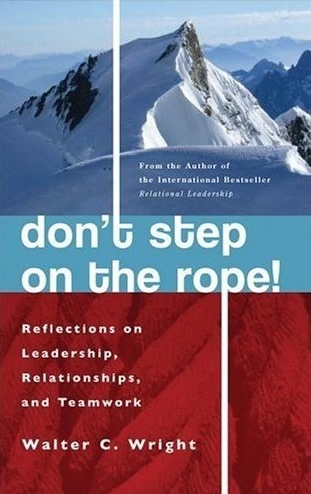
In his book, “Don’t Step on the Rope” author Walter Wright gives the following suggestions for executives as they lead their teams and honor the relationships in the organization.

Keep the purpose and goals before the team always and make sure they shared by all members and perceived as meaningful.
Build commitment and confidence within and among members, making sure that everyone is tied into the rope and belayed.
Strengthen the mix of technical and relational skills. Make sure everyone understands the skills needed and keep honing their abilities. Encourage the continual social interactions that build community.
Manage outside relationships with the larger organization or expedition and secure the support services required by the team.
Create opportunities for other to lead by delegating leadership back to the team members for specific area of responsibility.
Do real work. The leader is one member of the team roped up like everyone else – not “the leader,” but one member with leadership responsibility for this particular objective.

For more information on how DentistCEO provides expert dental consulting in Vancouver, WA to help you create your dream team, contact Dr. Brad Larsen of DentistCEO today!